
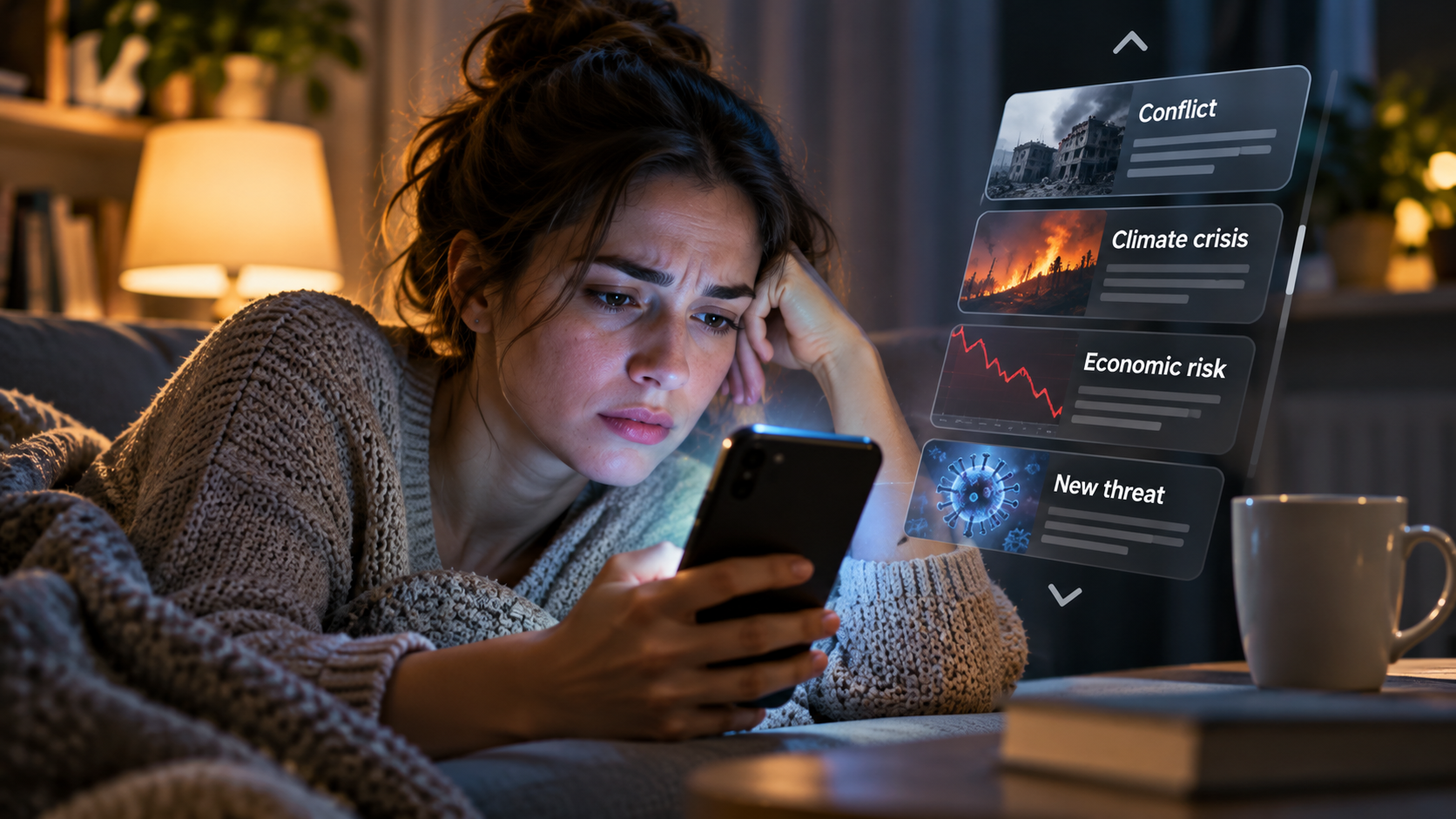
You pick up your phone to check one news story. Half an hour later, you are still reading about wars, crises, conflicts and threats. You feel increasingly anxious, yet you continue scrolling.
Does this sound familiar?
This behaviour is known as doomscrolling – repeatedly or continuously consuming negative and distressing news, even when we notice that it is affecting us emotionally.
In a world of constant information, the boundary between wanting to stay informed and developing a habit of following distressing events can easily become blurred.
Why do we keep searching for information that upsets us? And how can we stay informed without compromising our psychological wellbeing?
What Is Doomscrolling?
The term doomscrolling combines the English words doom, referring to catastrophe or disaster, and scrolling, the action of moving through digital content.
It describes the repeated consumption of negative news, often accompanied by difficulty stopping.
For example, you might begin by reading about economic instability. This is followed by a story about an international conflict, then a natural disaster, and finally a report about another global threat.
Each new story creates the impression that there is something else you need to understand.
The paradox is that we sometimes seek news to reduce uncertainty, yet excessive exposure to negative information may increase our anxiety.
Doomscrolling is not an officially recognised psychiatric diagnosis. It is a behavioural pattern studied in relation to anxiety, psychological distress and digital media use.
Why Does Negative News Capture Our Attention?
Human attention does not respond equally to every type of information.
Messages about danger, conflict or potential threats can be particularly effective at attracting our attention.
This sensitivity has an adaptive function: recognising possible risks is important for our safety.
However, digital environments can expose us to an almost continuous stream of distressing information.
The Search for Certainty
When we feel anxious, we often want to know more.
We hope that reading another article will help us understand the situation and restore our sense of control.
Sometimes additional information genuinely is useful.
However, when events are unpredictable and the news constantly changes, the search can continue without a clear endpoint.
Following the news may then become a repeated attempt to relieve anxiety without achieving lasting reassurance.
The Role of Social Media
Digital platforms can also encourage prolonged engagement with content.
Infinite scrolling, notifications and personalised recommendations reduce the natural opportunities we have to stop.
If we regularly interact with posts about crises or conflicts, some recommendation systems may present us with more similar content.
This does not mean that all algorithms operate in the same way or are designed to cause anxiety.
However, the way a platform is structured can make it more difficult to disengage from the information stream.
How Does Doomscrolling Affect Mental Health?
In 2026, researchers Qi Li and Xinrui Yin published a systematic review and meta-analysis examining 44 studies on doomscrolling.
The findings identified statistical associations between more intensive consumption of negative news and:
- Higher levels of anxiety.
- More depressive symptoms.
- Greater psychological distress.
- Lower psychological wellbeing.
- Reduced life satisfaction.
However, these findings require careful interpretation.
Most of the studies were observational, and the certainty of the available evidence was limited.
We cannot conclude with confidence whether doomscrolling causes anxiety, whether anxious individuals are more likely to engage in this behaviour, or whether the two processes reinforce each other.
The direction of the relationship may also differ between individuals.
How Can We Recognise Information Overload?
You do not need to spend hours online to notice negative reactions.
Pay attention to whether you:
- Check the news repeatedly without a specific reason.
- Continue reading even when you want to stop.
- Feel tense when you do not know the latest developments.
- Find it difficult to fall asleep after reading distressing news in the evening.
- Feel helpless or irritable after using social media.
- Postpone important tasks because you keep checking your phone.
These signs do not necessarily indicate a mental health disorder, but they may suggest that changing your digital habits could be helpful.
7 Ways to Reduce Doomscrolling
1. Identify Why You Are Checking the News
Before opening an app, ask yourself:
“What information do I actually need right now?”
If you have a specific question, it may be easier to stop once you have found the answer.
If you open your phone automatically, without a clear purpose, you may be acting out of habit rather than a genuine need for information.
2. Set Aside Time for News
Instead of following the news continuously, choose specific times during the day.
For example, you might spend 10–15 minutes checking the news in the morning and another short period in the afternoon.
This is a practical suggestion, not a scientifically established universal recommendation.
The aim is to reduce constant interruptions and preserve time for other activities.
3. Turn Off Unnecessary Notifications
Every notification can draw your attention back to the news feed.
Review your phone settings and keep only the alerts you genuinely need.
You can also use screen-time management tools to limit the time you spend on particular applications.
4. Choose Reliable Sources
You do not need to read dozens of articles about the same event.
Choose a few trustworthy sources that distinguish verified facts from speculation and commentary.
This may help reduce information overload and confusion.
5. Notice Your Emotional Reactions
Ask yourself how you feel before and after reading the news.
Did you obtain the information you needed?
Or do you feel more anxious, tense and confused?
If you notice that you are continuing to read mainly because you are afraid of missing something important, take a break.
6. Create an Evening Routine Without Distressing News
Try to limit exposure to negative news immediately before bedtime.
You could replace evening scrolling with reading, conversation, music or another relaxing activity.
If necessary, keep your phone out of immediate reach.
7. Focus on What You Can Change
Many negative news stories concern events over which we have limited influence.
This can create feelings of helplessness.
Ask yourself:
“Is there anything specific I can do about this?”
Sometimes you can support someone close to you, contribute to a community initiative or take reasonable precautions.
At other times, the most useful response may be to acknowledge the limits of your control and return your attention to everyday responsibilities.
Does a Digital Detox Help?
The expression digital detox usually refers to temporarily limiting the use of social media or particular applications.
It is not a medical procedure, but a popular term for changing digital habits.
Scientific studies have produced mixed findings.
A randomised controlled trial by Lambert and colleagues, published in 2022, found improvements in psychological wellbeing, anxiety and depressive symptoms following a one-week break from social media.
However, other studies have not identified the same benefits for all participants.
Completely stopping social media use is therefore not necessary for everyone.
A more sustainable goal is to develop habits that allow us to use technology consciously, without letting it constantly control our attention.
When Should We Seek Support?
Sometimes repeatedly checking distressing news may form part of a broader pattern of anxiety and difficulty coping with uncertainty.
If this behaviour interferes with your sleep, work, concentration or everyday functioning, consulting a psychologist may be helpful.
Professional support can help you understand why you feel compelled to check information constantly and develop more effective coping strategies.
For more information about the effects of prolonged stress, you can also explore Somenso’s section on stress symptoms and related conditions.
Conclusion: Staying Informed Without Constant Anxiety
Staying informed is important. It helps us understand events and make decisions.
However, having constant access to news does not mean we need to follow it continuously.
The goal is not to ignore the world’s problems, but to remain informed without losing our psychological balance.
Sometimes the most helpful decision is to put down the phone and return our attention to life beyond the screen.
Scientific sources
- Li, Q., & Yin, X. (2026). Doomscrolling, mental health, and psychological well-being in adolescents and adults: A systematic review and meta-analysis. Frontiers in Psychology, 17, 1893800. https://doi.org/10.3389/fpsyg.2026.1893800
- Satici, S. A., Gocet Tekin, E., Deniz, M. E., & Satici, B. (2023). Doomscrolling Scale: Its association with personality traits, psychological distress, social media use, and wellbeing. Applied Research in Quality of Life, 18, 833–847. https://doi.org/10.1007/s11482-022-10110-7
- Doomscrolling and mental well-being in social media users: A serial mediation through mindfulness and secondary traumatic stress. (2024). Journal of Community Psychology, 52, 512–524. https://doi.org/10.1002/jcop.23111
- Lambert, J., Barnstable, G., Minter, E., Cooper, J., & McEwan, D. (2022). Taking a one-week break from social media improves well-being, depression, and anxiety: A randomized controlled trial. Cyberpsychology, Behavior, and Social Networking, 25(5), 287–293. https://doi.org/10.1089/cyber.2021.0324
- Effects of restricting social media usage on wellbeing and performance: A randomized control trial among students. (2022). PLOS ONE, 17(8), e0272416. https://doi.org/10.1371/journal.pone.0272416
Edited and scientifically updated by: The Somenso Team
This article has been updated with additional scientific references, contemporary research and practical recommendations for managing information overload and developing healthier digital habits.