
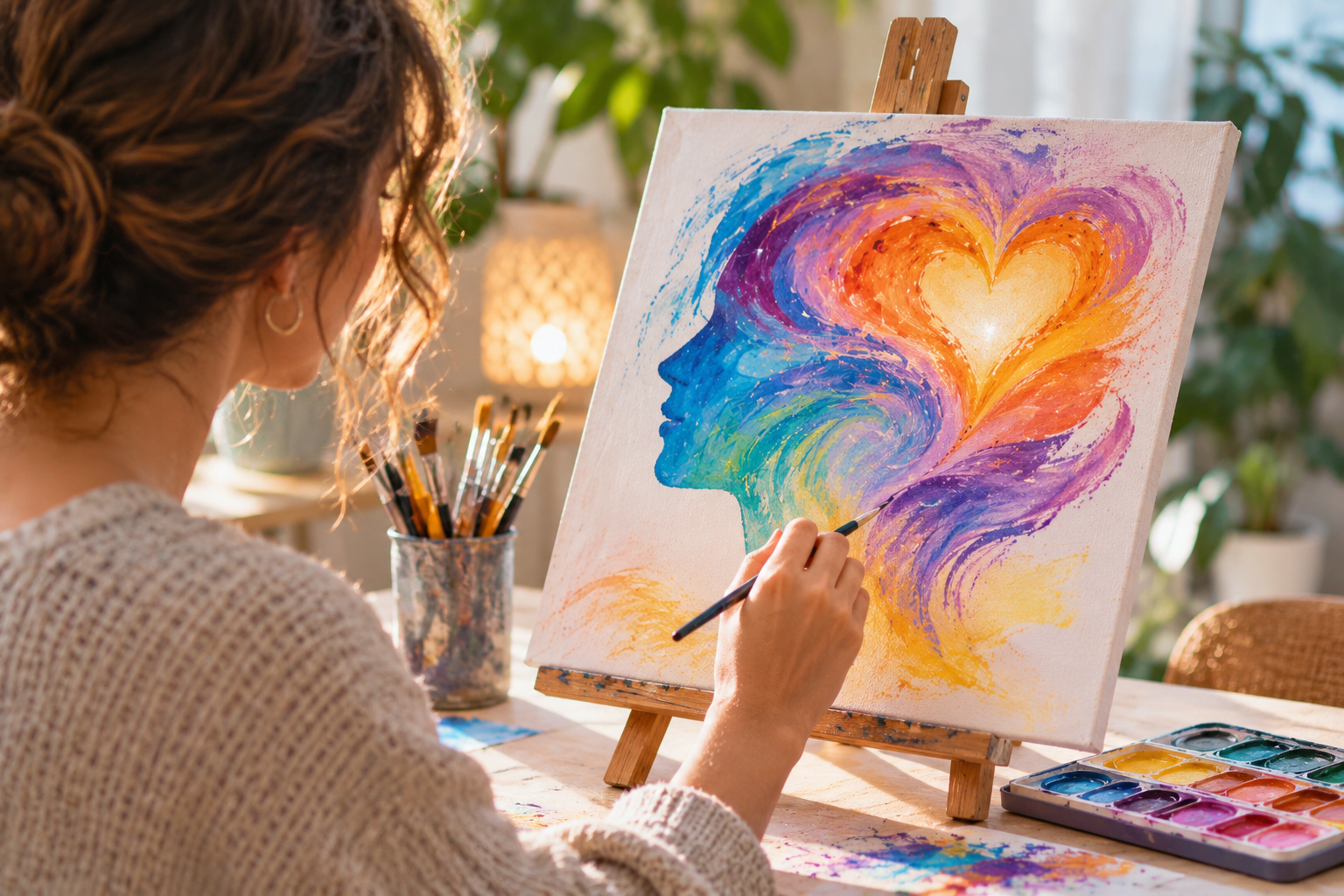
Have you ever experienced emotions so intense that you struggled to find the words to describe them? Sometimes anxiety, sadness or accumulated stress can be difficult to explain, even to those closest to us.
Art therapy offers a different way to express our experiences – through colours, lines, shapes and images.
It uses the creative process as part of professional psychological support. The aim is not to produce a beautiful work of art, but to find a way to explore our feelings, thoughts and experiences.
Most importantly, you do not need to know how to draw or have any artistic talent.
What Is Art Therapy?
Art therapy is a therapeutic approach that combines visual creativity with psychological work within a professional therapeutic relationship.
According to the American Art Therapy Association, the creative process, psychological theory and the therapeutic relationship are fundamental components of this approach.
Art therapy may involve:
- Drawing with pencils, pastels or paints.
- Working with clay and other modelling materials.
- Creating collages.
- Using colours, symbols and shapes.
- Combining different artistic techniques.
The focus of therapy is not the artistic quality of the finished work, but the person’s experience while creating it.
Art therapy is not a method of revealing hidden thoughts by analysing drawings.
Individual colours, shapes and symbols do not have universal psychological meanings. Their significance depends on the person’s own associations and experiences.
What Is the Difference Between Art Therapy and Drawing for Pleasure?
Many people find that drawing, colouring or working with clay helps them relax after a stressful day.
Creative activities can be enjoyable and may support psychological wellbeing.
However, not every creative activity is art therapy.
When we draw for pleasure, our main goal may be relaxation, enjoyment or creating something aesthetically pleasing.
In art therapy, the creative process is used intentionally to address specific psychological difficulties.
The therapist helps the person explore their emotions, thoughts and experiences without imposing predetermined interpretations.
For example, someone experiencing anxiety might draw an abstract representation of their tension. Afterwards, the therapist may ask what the image means to them and how they felt during the creative process.
What matters is the individual’s personal meaning, not whether the drawing is considered good.
What Happens During an Art Therapy Session?
The specific structure depends on the therapeutic approach, the goals of treatment and the individual’s needs.
A session generally includes several key elements.
Discussion and Setting Goals
At the beginning, the therapist discusses the client’s experiences and the reasons they are seeking support.
There is no need to share everything during the first session. Building trust is an important part of the therapeutic process.
Creative Activity
The therapist may suggest a particular task or provide an opportunity for free creative expression.
For example, a person might create an image of a place they associate with calmness or use colours to represent their current emotional state.
Reflection and Understanding
After the creative activity, the therapist may ask questions such as:
“What was it like for you to create this picture?”
“Which part of the image draws your attention?”
“What do the colours you chose mean to you?”
The aim is not for the therapist to make a diagnosis based on the artwork, but to support awareness and understanding of the person’s experiences.
Sometimes creative work brings a sense of calm, but it may also evoke difficult emotions. This is why professional support and an appropriate therapeutic framework are important.
What Difficulties Can Art Therapy Help With?
Art therapy is used in a range of psychological and healthcare settings.
Stress and Anxiety
The creative process may provide an opportunity to express tension, fear and worry.
For some people, it is easier to represent an experience visually before discussing it in words.
Research suggests potential benefits for anxiety, although the evidence is not equally convincing across all conditions.
Depressive Symptoms and Emotional Difficulties
Art therapy may be used as a complementary approach for people experiencing depressive symptoms or difficulties expressing emotions.
A systematic review and meta-analysis published in 2024 found positive outcomes among adults with depressive symptoms, but rated the quality of the evidence as low.
This means that further high-quality research is needed.
Loss and Major Life Changes
A relationship breakdown, the death of a loved one or a significant life transition can trigger complex emotional reactions.
Art therapy may offer a space to explore these experiences, particularly when they are difficult to describe in words.
Support During Serious Illness
Art therapy is also used as part of psychological support for people living with chronic illnesses or cancer.
It may help individuals express fear, uncertainty and changes in how they perceive themselves.
However, it is important to emphasise that art therapy does not treat the physical illness and cannot replace medical care.
What Does Scientific Research Tell Us?
Scientific interest in art therapy is growing, but the evidence for its effectiveness remains mixed.
A systematic review and meta-analysis published in JAMA Network Open in 2024 examined the results of randomised clinical trials involving visual art therapy.
The researchers identified positive effects on some of the health outcomes assessed. However, they also highlighted substantial differences between studies and the low quality of much of the available evidence.
Another meta-analysis published in 2024, including 15 randomised trials with a total of 932 participants, found reductions in depressive symptoms among adults, while also identifying limitations in the quality of the evidence.
Scientific findings support art therapy as a potentially helpful approach for certain groups of people, but they do not establish universal effectiveness for all psychological difficulties.
When treating diagnosed mental health conditions, the choice of therapy should be based on an individual assessment and the available scientific evidence.
Do You Need to Be Good at Drawing?
No.
Art therapy is not an art class and does not require any previous artistic skills.
There are no grades, competitions or expectations about how the finished work should look.
You can use simple lines, patches of colour or materials you feel comfortable working with.
You do not even need to like the final result.
What matters more is what you experienced during the creative process and whether it helped you discover a new way to understand or express yourself.
How Can You Choose a Qualified Art Therapist?
If you are considering art therapy, it is important to pay attention to the therapist’s professional qualifications.
You may wish to ask about their education and specialist training, the psychological difficulties they work with and how they establish therapeutic goals.
It is also important to understand how confidentiality is maintained, how artwork is stored and how it is used within the therapeutic process.
Professional qualifications and regulatory requirements vary between countries.
Art therapy is one of several possible approaches to psychological support. The most appropriate method depends on the individual’s specific needs.
Conclusion: When Words Are Not Enough
Not all emotions and experiences can easily be expressed in words.
Sometimes a drawing, shape or colour can become the starting point for a conversation about something that has previously been difficult to share.
Art therapy provides an opportunity for this kind of expression within a professional therapeutic process.
It is not a universal solution to every psychological problem, but it may be a valuable part of individually tailored support.
You do not need to be an artist to use creativity as a means of self-understanding.
Scientific sources
- American Art Therapy Association. What Is Art Therapy? Official definition.
- British Association of Art Therapists. What Is Art Therapy? Official information.
- Joschko, R., Klatte, C., Grabowska, W. A., Roll, S., Berghöfer, A., & Willich, S. N. (2024). Active Visual Art Therapy and Health Outcomes: A Systematic Review and Meta-Analysis. JAMA Network Open, 7(9), e2428709. https://doi.org/10.1001/jamanetworkopen.2024.28709
- Han, B., Jia, Y., Hu, G., et al. (2024). The effects of visual art therapy on adults with depressive symptoms: A systematic review and meta-analysis. International Journal of Mental Health Nursing, 33(5), 1183–1196. https://doi.org/10.1111/inm.13331
Further information and support
Cognitive behavioural therapy (CBT) explained
REBT: rational emotive behaviour therapy