
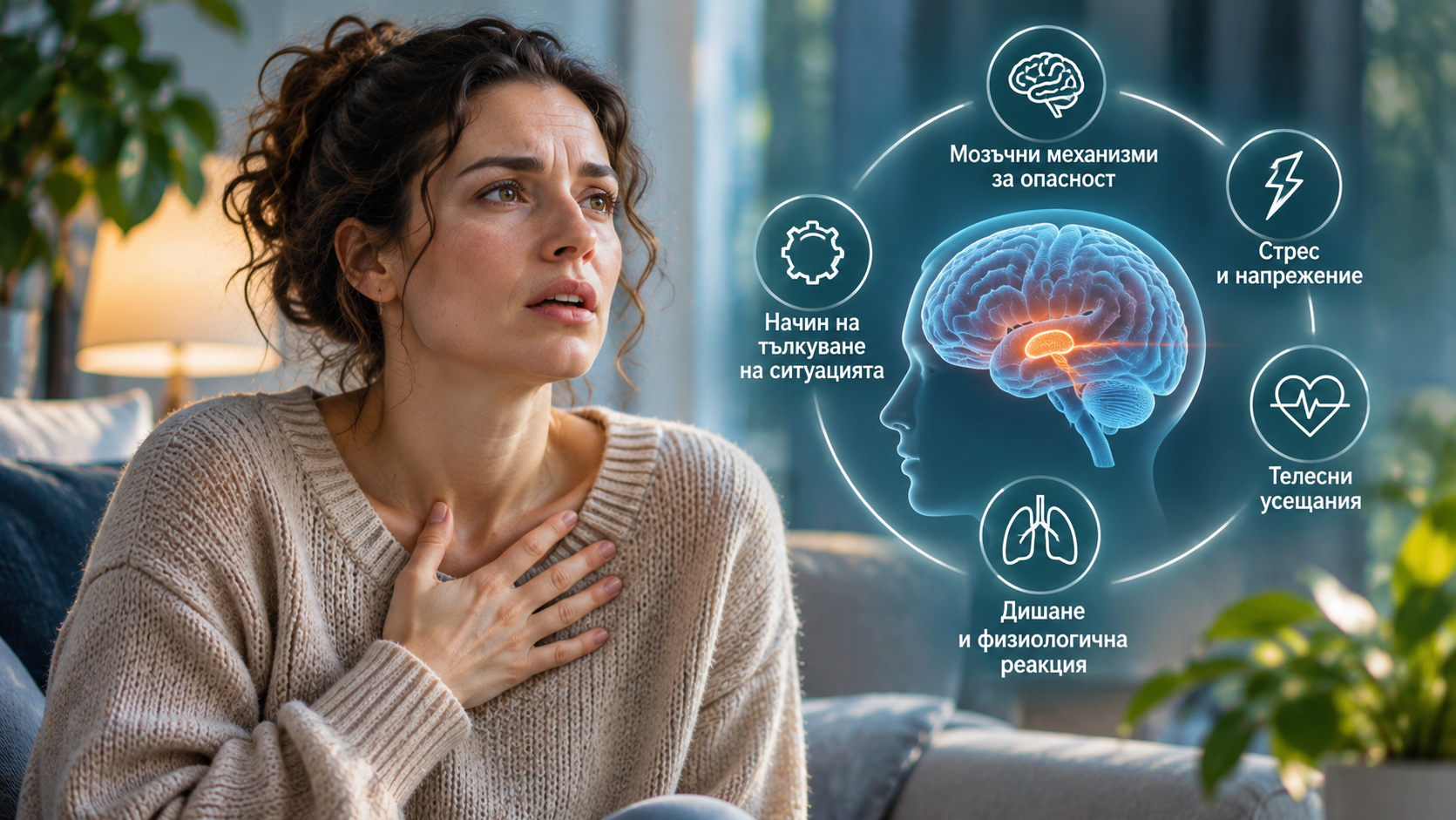
Why does the brain sometimes react as if we are in danger, even when no immediate threat is present? Panic attacks can occur suddenly, cause intense physical symptoms and leave a lasting fear of another episode. Understanding the mechanisms behind them is an important step towards effective management and recovery.
Your heart suddenly starts racing. Your breathing becomes faster, you feel dizzy, experience tightness in your chest or struggle to get enough air. You may become overwhelmed by the fear of fainting, losing control or even dying.
This is how a panic attack often begins.
For someone experiencing these symptoms for the first time, the sensation can be extremely frightening. Sometimes the symptoms are so intense that people seek emergency medical attention, convinced they are having a heart attack or another serious medical emergency.
But what actually causes panic attacks? Why do they sometimes occur without an obvious reason, and what role does chronic stress play?
Modern psychology and neuroscience suggest that panic attacks do not have a single cause. They arise through interactions between the brain’s threat-detection mechanisms, the autonomic nervous system, the interpretation of bodily sensations and individual sensitivity to stress.
You can read more about the symptoms and management of anxiety in Anxiety and Panic Attacks: Symptoms and What Helps.
Contents
- What is a panic attack?
- What happens in the brain during a panic attack?
- Seven major causes and contributing factors
- Why can panic attacks occur without an obvious trigger?
- Could the symptoms indicate another medical condition?
- What helps during a panic attack?
- Why is chronic stress assessment important?
- Can panic attacks be overcome?
- Scientific references
What is a panic attack?
A panic attack is a sudden episode of intense fear or discomfort that reaches its peak within minutes.
It may involve a combination of physical and psychological symptoms, including:
- Rapid heartbeat or strong palpitations.
- Difficulty breathing or a sensation of choking.
- Chest pain or tightness.
- Sweating, trembling or chills.
- Dizziness or feeling unsteady.
- Numbness or tingling in the extremities.
- Feelings of unreality or detachment from one’s body.
- Fear of losing control or dying.
Experiencing a panic attack does not necessarily mean that a person has a mental health disorder.
Panic disorder is characterised by recurrent, unexpected panic attacks accompanied by persistent concern about additional attacks or significant behavioural changes intended to prevent them.
Diagnosis requires professional assessment and consideration of other possible causes of the symptoms.
What happens in the brain during a panic attack?
The brain constantly processes information about potential threats in the environment and the body’s internal condition.
When danger is perceived, protective mechanisms are activated to prepare the body for action.
Several interconnected brain systems participate in this response.
The amygdala contributes to processing emotionally significant stimuli and generating fear-related responses.
The insula plays an important role in interoception – the ability to perceive internal bodily signals such as heartbeat, breathing and physical tension.
The prefrontal cortex is involved in evaluating situations, making decisions and regulating emotional responses.
The brainstem and hypothalamus contribute to the regulation of autonomic and defensive physiological reactions.
During a panic attack, these systems may produce an intense response to a perceived threat, even when there is no immediate external danger.
The sympathetic nervous system becomes activated. Heart rate increases, breathing changes and muscles become tense.
These are normal protective mechanisms.
Difficulties arise when the response is disproportionate to the situation or when bodily sensations are interpreted as evidence of serious danger.
Seven major causes and contributing factors of panic attacks
1. Chronic stress and accumulated tension
Chronic stress can increase vulnerability to panic reactions.
When someone experiences prolonged professional, family or emotional pressure, the body repeatedly mobilises resources to adapt.
This may be accompanied by sleep disturbances, muscle tension, changes in breathing and increased attention to physical sensations.
For example, someone who has been working under intense pressure and sleeping poorly may suddenly notice their heart racing.
If they interpret this sensation as a sign of serious illness, anxiety may increase rapidly.
It is important to emphasise that chronic stress is neither a necessary nor a sufficient cause of panic attacks. Panic attacks can also occur without obvious ongoing stress.
2. Fear of bodily sensations
One of the best-researched psychological mechanisms in panic disorder is the catastrophic interpretation of bodily sensations.
For example:
- A rapid heartbeat may be interpreted as an approaching heart attack.
- Dizziness may be perceived as a sign of impending fainting.
- Shortness of breath may trigger fear of suffocation.
- Temporary feelings of unreality may be interpreted as losing control.
This can create a self-reinforcing cycle.
Bodily sensation → catastrophic interpretation → fear → increased physiological arousal → stronger bodily sensations.
Imagine noticing your heart beating rapidly and thinking, “Something dangerous is happening to me.”
Fear increases physiological arousal, making the heartbeat even more noticeable. This seems to confirm the original belief.
This mechanism is central to cognitive models of panic disorder.
3. Changes in breathing
Breathing is closely connected to the body’s physiological responses to anxiety.
During intense stress, some people begin breathing faster or more deeply than necessary.
This can reduce carbon dioxide levels in the blood and produce symptoms such as:
- Dizziness.
- Tingling in the fingers.
- Chest discomfort.
- Feelings of unreality.
These sensations may intensify fear.
Research also suggests that some people with panic disorder show increased sensitivity to changes in carbon dioxide levels.
However, not every panic attack is caused by hyperventilation.
4. Genetic and biological predisposition
Research indicates that hereditary factors can influence the risk of developing panic disorder.
This does not mean the condition will inevitably be passed from parents to children.
Individual differences in fear processing, autonomic regulation, interoception and stress reactivity may also contribute.
Modern neuroscience understands panic disorder as involving interactions between multiple brain systems rather than a single chemical imbalance.
5. Traumatic experiences and major life changes
The loss of a loved one, serious illness, experiences of violence, major conflicts or significant life changes may be associated with increased anxiety.
Panic symptoms can sometimes begin during a difficult period or emerge after the immediate crisis has passed.
However, not everyone experiencing panic attacks has a history of trauma.
It is not necessary to assume that a hidden traumatic event must explain the panic.
6. Insufficient sleep and stimulating substances
Sleep deprivation can make emotional regulation more difficult and increase sensitivity to stress.
For some people, high consumption of caffeine, energy drinks or nicotine can cause palpitations, nervousness and other sensations resembling the beginning of a panic attack.
Certain medications, psychoactive substances and withdrawal reactions may also trigger anxiety-related symptoms.
Assessing recurrent panic attacks should therefore include a discussion of medications, supplements and substance use.
7. Fear of another panic attack
After the first episode, some people begin continuously monitoring their heartbeat, breathing and other bodily sensations.
A recurring question appears:
“What if it happens again?”
Over time, avoidance behaviours may develop.
For example, someone may stop using public transport, avoid physical activity or become afraid of being alone.
In the short term, avoidance can provide relief. In the longer term, however, it may reinforce the belief that certain situations or sensations are dangerous.
Anticipatory anxiety can therefore become an important factor in maintaining the problem.
Why can panic attacks occur without an obvious trigger?
One of the most common questions is:
“Why did I have a panic attack when I was feeling calm?”
The brain does not respond only to consciously perceived events.
It continuously processes information about the body’s internal condition, including heart rate, breathing, temperature and other physiological signals.
Sometimes a change in one of these signals may trigger an anxiety response without the person identifying a specific external cause.
This helps explain why panic attacks can occur while resting, watching television or even sleeping.
The absence of an obvious trigger does not mean the reaction is inexplicable.
However, these mechanisms cannot explain every individual episode and do not replace medical assessment.
Could the symptoms indicate another medical condition?
Yes. This is particularly important when someone experiences sudden palpitations, breathlessness, chest pain or dizziness for the first time.
Several medical conditions can produce similar symptoms, including:
- Cardiac arrhythmias and other cardiovascular conditions.
- Hyperthyroidism.
- Asthma and other respiratory disorders.
- Hypoglycaemia.
- Adverse reactions to certain medications or substances.
It is therefore important not to assume that every episode of these symptoms is psychological.
Sudden severe chest pain, significant breathing difficulties, loss of consciousness or newly developed neurological symptoms require emergency medical attention.
In Bulgaria and other European Union countries, the emergency number is 112.
What helps during a panic attack?
Once possible medical causes have been appropriately assessed and a person recognises their characteristic panic symptoms, several strategies may help.
Understand what is happening
Understanding the mechanisms of panic can reduce fear of the body’s own reactions.
Panic attacks usually reach peak intensity within minutes and gradually subside, although some symptoms and anxiety may persist afterwards.
Focus on the present moment
Try naming objects you can see around you or noticing the contact between your feet and the floor.
This may help redirect attention away from constant monitoring of bodily sensations.
Breathe calmly
Try to maintain gentle, regular breathing.
There is no need to force excessively deep breaths or attempt to control every change in your breathing.
Seek professional help for recurrent attacks
Cognitive behavioural therapy (CBT) is one of the most extensively studied treatments for panic disorder.
It addresses catastrophic interpretations of bodily sensations, avoidance behaviours and anticipatory anxiety.
Treatment may include interoceptive exposure, which involves gradual, controlled exposure to feared bodily sensations.
This technique should be used following appropriate assessment and under the guidance of a qualified professional.
In some cases, a psychiatrist may also recommend medication.
Why is assessing chronic stress important?
A panic attack is an acute episode, but in some individuals it occurs alongside longer-term changes in psychological and physiological functioning.
Assessment should therefore consider more than simply how to manage the next attack.
Relevant factors may include:
- Prolonged professional or personal stress.
- Poor sleep and inadequate recovery.
- Elevated anxiety.
- Emotional exhaustion.
- Physical health and coexisting medical conditions.
At Somenso, we examine chronic stress through the interaction of psychological, cognitive and physiological processes.
An integrated assessment may help individuals better understand their stress profile and identify appropriate next steps.
An important distinction is necessary:
Chronic stress screening does not diagnose panic disorder and cannot replace medical or psychiatric assessment.
It may, however, provide additional information about factors relevant to overall health and prevention.
You can learn more about interpreting screening results in Test My Stress: Report and Consultation.
Can panic attacks be overcome?
Yes. Effective treatments are available for panic disorder.
Many people experience substantial improvement through appropriate psychotherapy and, when indicated, medication.
An important step is understanding that panic is not a sign of personal weakness or insufficient willpower.
It involves genuine psychophysiological processes connected with threat detection, bodily regulation and learning.
The aim of treatment is not to eliminate every experience of fear or increased heart rate.
Instead, it is to reduce disproportionate fear of these sensations and gradually restore freedom of action in everyday life.
Panic attacks can be extremely frightening, but with appropriate assessment, understanding and professional support, people can regain confidence and reduce the limitations that anxiety creates.
Scientific sources
- Kyriakoulis, P., & Kyrios, M. (2023). Biological and Cognitive Theories Explaining Panic Disorder: A Narrative Review. Frontiers in Psychiatry, 14, 957515. https://doi.org/10.3389/fpsyt.2023.957515
- Brain Mechanisms Underlying Panic Attack and Panic Disorder. (2023). Neuroscience Bulletin, 40(6), 795–814. https://doi.org/10.1007/s12264-023-01088-9
- The Cognitive Theory of Panic Disorder: A Systematic Narrative Review. (2024). Clinical Psychology Review. https://doi.org/10.1016/j.cpr.2024.102483
- Interoception, Conditioning, and Fear: The Panic Threesome. (2019). https://pubmed.ncbi.nlm.nih.gov/31228272/
- National Institute of Mental Health (NIMH). Panic Disorder: What You Need to Know. https://www.nimh.nih.gov/health/publications/panic-disorder-when-fear-overwhelms
- National Institute for Health and Care Excellence (NICE). Generalised Anxiety Disorder and Panic Disorder in Adults: Management. Clinical Guideline CG113. https://www.nice.org.uk/guidance/cg113
- American Psychiatric Association. (2022). Diagnostic and Statistical Manual of Mental Disorders, Fifth Edition, Text Revision (DSM-5-TR). American Psychiatric Association Publishing.