
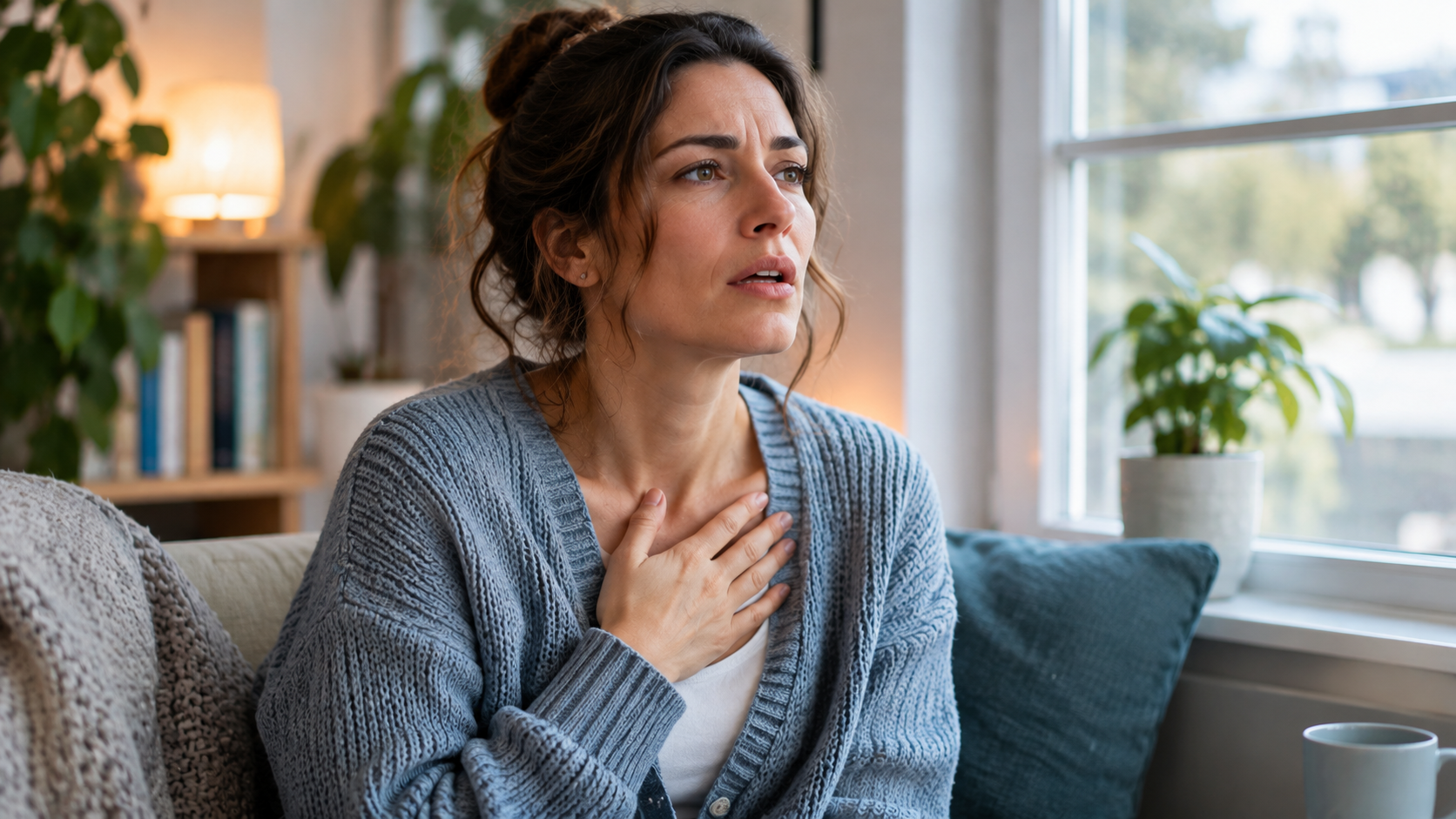
Your heart starts beating fast, you find it hard to breathe, your hands go numb, and you are suddenly overcome by the feeling that something terrible is about to happen. You might think you’re having a heart attack, that you’re going to faint, or that you’re losing control. This is often what a panic attack feels like – one of the most intense experiences of fear a person can go through.
Panic attacks can occur unexpectedly, even when there is no obvious danger. They are accompanied by pronounced physical symptoms, which are sometimes so severe that a person seeks urgent medical help.
Although the experience is extremely frightening, the panic reaction itself usually subsides. It is important to note, however, that similar symptoms can also occur in medical conditions that require treatment.
What actually happens in the body during a panic attack? Why do these episodes sometimes recur, and how can we break the cycle of fear?
What is a panic attack?
A panic attack is a sudden episode of intense fear or discomfort that peaks within a few minutes.
It is linked to the activation of the systems that prepare the body to respond to a threat.
When the brain perceives danger, the sympathetic nervous system becomes more active. The heart rate and breathing speed up, the muscles tense, and attention is focused on the potential threat.
This is part of the natural ‘fight-or-flight’ response, which serves a protective function.
During a panic attack, however, this response may be triggered without any real immediate danger, or it may be disproportionate to the situation.
As a result, a person experiences intense physical changes, which may be perceived as a sign of a serious illness or a loss of control.
How long does a panic attack last?
One of the most common questions is how long a panic attack can last.
Most panic attacks last between 5 and 20 minutes, with the most intense symptoms usually developing within the first few minutes.
For some people, the attack is shorter, whilst for others it lasts longer. It is possible that, once the most intense symptoms have subsided, feelings of tension, tiredness, trembling or fear of another attack may remain.
Sometimes a person feels as though the panic is continuing for hours. This may be due to successive attacks, ongoing anxiety or residual physical sensations.
It is important to distinguish the panic attack itself from anxiety, which can last considerably longer.
The frequency of attacks also varies. Some people experience just one panic attack in their lifetime, whilst for others they recur.
A
single
panic attack does not necessarily mean that a person has panic disorder.
What are the symptoms of a panic attack?
Panic attacks can cause a variety of physical and psychological symptoms.
The most common are:
- A strong or rapid heartbeat.
- A feeling of shortness of breath.
- Tightness or discomfort in the chest.
- Dizziness, unsteadiness or a feeling of fainting.
- Trembling and sweating.
- Chills or sudden hot flushes.
- Numbness in the arms, legs or face.
- Nausea or stomach discomfort.
- A feeling that the surroundings are unreal.
- A feeling of being detached from one’s own body.
- Fear of death, loss of control or ‘going mad’.
Not all symptoms need to be present at the same time.
For some people, palpitations and shortness of breath are the predominant symptoms. For others, dizziness, numbness or a sense of unreality are the most pronounced.
As the symptoms may resemble a heart attack, cardiac arrhythmia, an asthma attack or another medical condition, medical assessment is essential, particularly during the first episode.
In the event of new or severe chest pain, severe shortness of breath, fainting, sudden weakness or other worrying symptoms, you must immediately seek emergency medical assistance by calling 112.
We should not automatically assume that all such complaints are due to anxiety.
Why do panic attacks occur?
There is no single cause for panic attacks.
Current research suggests that they may arise as a result of the interaction between biological, psychological and environmental factors.
Genetic predisposition
Panic disorder is more common in people who have close relatives with similar difficulties.
This suggests that hereditary factors play a part, but a genetic predisposition does not mean that a person will necessarily develop panic attacks.
Sensitivity to bodily sensations
Some people are more sensitive to changes in heart rate, breathing or balance.
For example, a rapid heartbeat following physical exertion may be perceived as a sign of danger.
When normal bodily sensations are interpreted as catastrophic, fear can intensify and trigger a panic reaction.
This mechanism is important in cognitive models of panic disorder.
Prolonged stress
Chronic stress can raise the overall level of physiological arousal and hinder the body’s ability to recover.
When a person lives under stress for a prolonged period, sleep disturbances, fatigue and a constant sense of anxiety can increase vulnerability to panic reactions.
However, stress is not necessarily the cause of panic attacks and does not explain all cases.
Significant life events
The loss of a loved one, a break-up, career changes, illness or prolonged family conflicts can increase psychological strain.
Even positive life events, such as the birth of a child or starting a new job, are sometimes accompanied by significant changes and stress.
Previous adverse experiences
For some people, a history of traumatic experiences or prolonged insecurity may be linked to higher levels of anxiety.
This does not mean that every panic attack is the result of childhood trauma or that there is necessarily an underlying psychological conflict.
Medical conditions and substances
Symptoms resembling a panic attack may be linked to heart rhythm disorders, thyroid conditions, respiratory problems, the effects of medication, or the use of stimulants.
Caffeine, nicotine and certain psychoactive substances can exacerbate anxiety and physical symptoms in susceptible individuals.
Therefore, a professional assessment must take into account both psychological and medical factors.
How does the vicious circle of panic arise?
One of the best-studied mechanisms underlying panic attacks is what is known as ‘fear of fear
’.
Imagine the following situation.
You are travelling on the underground and suddenly feel your heart starting to beat faster.
At first, the change may be due to tiredness, stress or a perfectly normal physiological reaction.
But your attention is immediately drawn to the palpitations.
The thought arises: ‘Something’s wrong. Perhaps I’m having a heart attack.’
This thought increases your anxiety.
Your body reacts with even greater physiological arousal. Your heart starts beating harder, your breathing changes, and you feel dizzy.
These sensations seem to confirm that something dangerous is indeed happening.
The fear intensifies and the cycle continues.
Schematically, this process can be represented as follows:
Physical sensation → catastrophic interpretation → fear → increased physiological arousal → stronger physical sensations → even greater fear.
This is one of the mechanisms through which a panic attack can develop and intensify.
It is important to note that this model does not explain every panic attack and does not imply that a person is consciously causing their symptoms.
Why does the fear of another panic attack arise?
After the first attack, many people begin to worry that it might happen again.
Gradually, their attention turns to every change in their body.
They check their pulse, monitor their breathing and watch out for any signs of dizziness.
Sometimes they start to avoid places where they have experienced a panic attack.
For example, someone who has had an attack in a supermarket might only go shopping when there are few people around.
Another person might avoid public transport, travelling or being alone at home.
In the short term, avoidance brings relief.
But in the long term, it can reinforce the belief that certain situations are dangerous and that the person would be unable to cope with them.
This gradually restricts their daily life.
When do we talk about panic disorder?
A panic attack is a single episode of intense fear. Panic disorder is a clinical condition characterised by recurrent, unexpected panic attacks, accompanied by persistent anxiety or behavioural changes.
According to the diagnostic criteria, following at least one such attack, there must be a period of one month or more during which the person experiences constant worry about further attacks or their consequences, and/or significantly alters their behaviour in relation to the attacks.
The diagnosis also requires the exclusion of other possible causes of the symptoms.
Panic disorder may be accompanied by agoraphobia – an intense fear or anxiety in situations from which a person believes it would be difficult to escape or to get help.
However, the two conditions are not one and the same and can exist independently.
You can read more about the manifestations of anxiety on the Somenso page ‘Anxiety and panic attacks: symptoms and what helps’.
How should we react during a panic attack?
When a panic attack begins, the strongest urge is often for the symptoms to stop immediately.
But constantly trying to control every physical sensation can sometimes make the anxiety worse.
If you have already undergone a medical assessment and recognise your typical panic reaction, the following approaches may be helpful.
1. Recognise what is happening
Try to put a name to the experience:
‘This feels like a panic attack. I’m experiencing intense fear and physical arousal. These sensations will change and gradually subside.’
Putting a name to the experience can help reduce the tendency to interpret it in a catastrophic way.
However, it is important not to use this explanation to ignore any new, unusual or severe symptoms that require medical attention.
2. Focus on your breathing
During a panic attack, breathing often becomes rapid or shallow.
This can contribute to dizziness, numbness and a feeling of shortness of breath.
Try to slow your breathing down gradually, without taking excessively deep breaths.
You can breathe in calmly through your nose and breathe out a little more slowly, if that feels comfortable.
There’s no need to aim for a specific number of seconds.
The aim is to make your breathing more even, not to force it.
Do not use a paper bag to breathe into, as this can be dangerous in certain medical conditions.
3. Bring your attention back to your surroundings
When we’re completely focused on physical symptoms, anxiety can intensify.
You could try a short exercise to ground yourself in the present moment.
Look around and name a few objects you can see.
Pay attention to the sounds around you, the feel of your feet on the floor, or an object you are holding in your hand.
Exercises like these can help some people reduce the intensity of their experience.
4. Do not try to eliminate every sensation
A panic attack is unpleasant, but constantly fighting the symptoms can keep your attention focused on them.
Instead of constantly checking whether your heart is beating faster, try to allow the physical sensations to gradually subside.
This does not mean accepting the problem, but rather changing the way you react to a panic reaction you have already recognised.
5. Avoid hasty decisions
During an attack, fear may prompt you to leave the place immediately or stop what you are doing.
If the environment is safe and the symptoms are typical of panic attacks you have already recognised, try not to make escape your only coping strategy.
If necessary, sit down in a safe place and seek support from someone you trust.
Gradually overcoming avoidance is an important part of specialist therapy, but it is best carried out according to a structured plan.
What helps to reduce recurrent panic attacks?
Coping with panic attacks is not just about managing individual episodes.
It is important to understand what fuels anxiety and to work on the factors that increase vulnerability to new episodes.
Maintain a regular sleep pattern
Insufficient sleep can increase emotional reactivity and sensitivity to stress.
Aim for a consistent routine and allow sufficient time for recovery.
Limit stimulants
If you notice that caffeine or nicotine are making your heart race or increasing your anxiety, discuss with a healthcare professional how best to limit your intake.
Stay physically active
Regular exercise can help manage stress, sleep and overall mental health.
For people who are anxious about a rapid heartbeat, physical activity can sometimes help restore confidence in normal bodily reactions.
However, specialised exercises designed to gradually help you get used to bodily sensations are best carried out under the guidance of a therapist.
Identify sources of stress
Pay attention to the periods when your anxiety intensifies.
It may be linked to your workload, lack of rest, ongoing conflicts or significant life changes.
Sometimes it is necessary not only to develop coping strategies, but also to change the circumstances that are fuelling the stress.
Don’t face the problem alone
Talking to loved ones can be an important source of support.
But when panic attacks start to interfere with daily life, professional psychological help can be crucial to recovery.
How is panic disorder treated?
Panic disorder is a treatable condition.
One of the best-researched approaches is cognitive-behavioural therapy (CBT).
It helps people understand the connection between bodily sensations, thoughts, emotions and behaviour.
Therapy may involve techniques for addressing catastrophic interpretations, gradual exposure to avoided situations, and interoceptive exposure – controlled work with specific bodily sensations that trigger fear.
The aim is not for the person to never experience anxiety again.
The aim is to reduce the fear of the symptoms themselves and gradually restore freedom of action.
In certain cases, medication may be recommended, most commonly antidepressants from the selective serotonin reuptake inhibitor (SSRI) group.
The choice of treatment depends on the severity of the symptoms, the patient’s individual condition and preferences, and should be made in consultation with a qualified specialist.
Current clinical guidelines regard cognitive-behavioural therapy and appropriate pharmacotherapy as the main effective methods of treatment.
Is it possible to make a full recovery?
Many people experience significant improvement and are able to lead a full life once again without being constantly restricted by fear.
For some, the symptoms subside for a prolonged period. For others, they may reappear, particularly during periods of increased stress.
The important thing is that, with the right support, a person can learn to understand their symptoms, reduce avoidance behaviour and cope more effectively with anxiety.
The sooner you seek appropriate help, the greater the chance of preventing these limitations from becoming more severe in your daily life.
A panic attack does not define your life
One of the most difficult consequences of panic attacks is not the attack itself, but the fear that it will happen again.
Gradually, this fear can begin to dictate where we go, how we travel, who we meet and the decisions we make.
But panic attacks do not mean that a person is weak, that they are losing their mind or that there is no possibility of change.
They are experiences linked to complex mechanisms of anxiety and physiological arousal, which can be understood and managed.
The first step is not to be afraid to seek an explanation and help. The next step is to gradually rebuild our confidence that we can live life to the full, without the fear of another attack dictating our daily lives.
Scientific sources
- National Institute of Mental Health (NIMH). Panic Disorder: What You Need to Know. https://www.nimh.nih.gov/health/publications/panic-disorder-when-fear-overwhelms
- National Institute for Health and Care Excellence (NICE). Generalised Anxiety Disorder and Panic Disorder in Adults: Management. Clinical Guideline CG113. https://www.nice.org.uk/guidance/cg113
- National Health Service (NHS). Panic Disorder. https://www.nhs.uk/mental-health/conditions/panic-disorder/
- Clark, D. M. (1986). A Cognitive Approach to Panic. Behaviour Research and Therapy, 24(4), 461–470. https://doi.org/10.1016/0005-7967(86)90011-2
- Craske, M. G., & Barlow, D. H. (2007). Mastery of Your Anxiety and Panic: Therapist Guide. Oxford University Press.
- American Psychiatric Association. (2022). Diagnostic and Statistical Manual of Mental Disorders, Fifth Edition, Text Revision (DSM-5-TR). American Psychiatric Association Publishing. https://doi.org/10.1176/appi.books.9780890425787
- Association for Behavioural and Cognitive Therapies (ABCT). Panic Disorder – Fact Sheet. https://www.abct.org/fact-sheets/panic-disorder/