
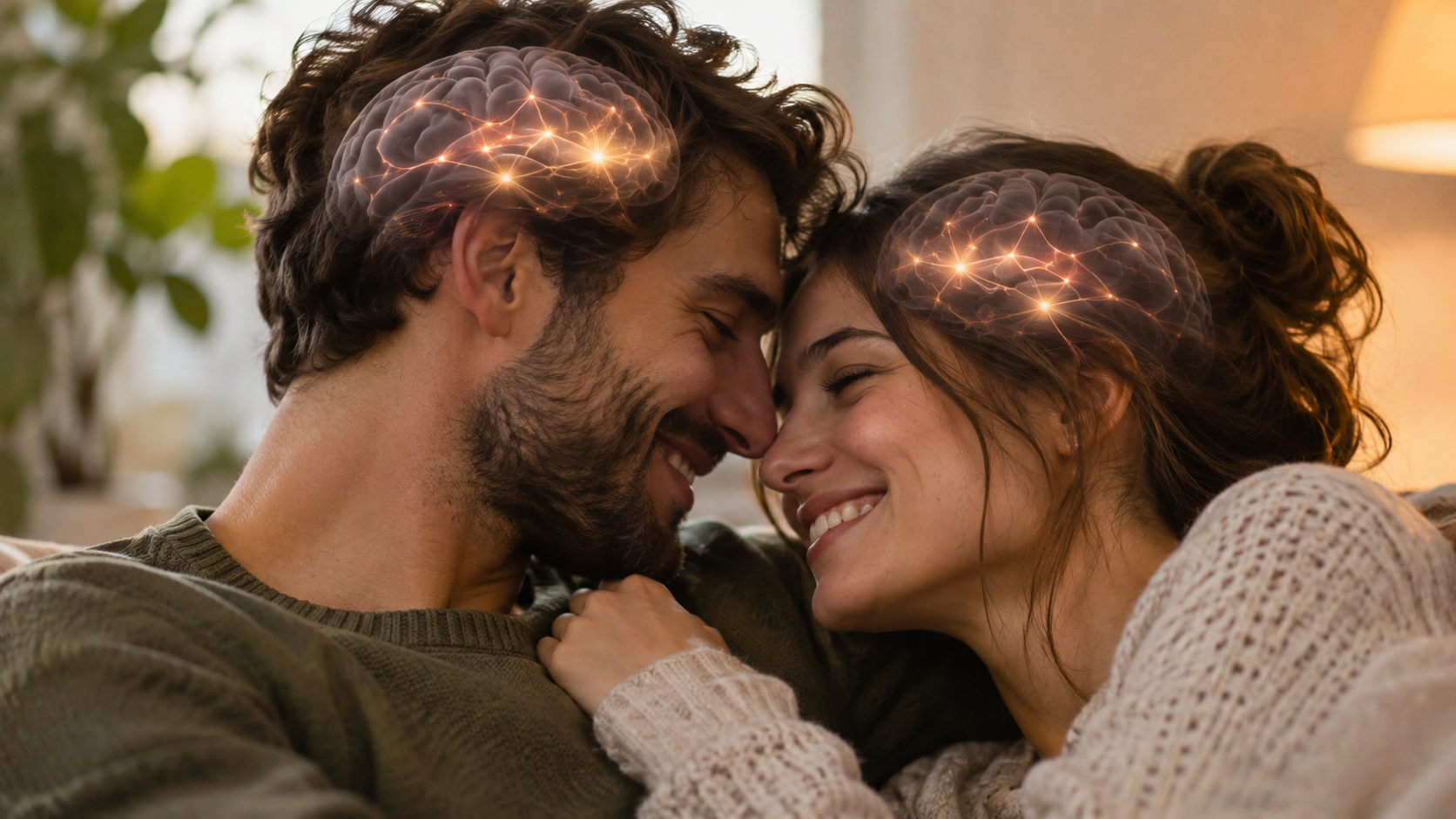
Your heart beats faster when you see someone special. You think about them even when you are busy with something else. You look forward to your next meeting, and a single message can change your mood for the entire day.
What happens in our brain when we fall in love, and why can this experience feel so intense?
Love often seems impossible to explain, but neuroscience is gradually revealing some of the mechanisms involved in romantic attraction.
Research shows that falling in love engages brain systems associated with motivation, reward, attention and social attachment.
However, love is not simply the result of a few hormones. It is a complex experience in which biology, personal history and relationships interact.
Why Is Falling in Love Such an Intense Experience?
During the early stages of a romantic relationship, many people experience unusually strong excitement.
Their thoughts frequently return to the person they love, their attention becomes focused on anything associated with them, and the anticipation of meeting can produce a pleasant sense of excitement.
Physical reactions may also occur:
- An increased heart rate.
- A feeling of “butterflies in the stomach”.
- Changes in appetite and sleep.
- Increased energy.
- A strong desire for closeness.
These experiences are associated with interactions between emotional processes, the autonomic nervous system and the brain’s motivational mechanisms.
However, not everyone experiences falling in love in the same way. The intensity of these reactions depends on individual characteristics, life experiences and the particular relationship.
What Do Brain Imaging Studies Reveal?
One of the most interesting questions in neuroscience is how the brain responds when we see someone we are in love with.
In a landmark study published in 2005, Arthur Aron, Helen Fisher and their colleagues used functional magnetic resonance imaging (fMRI) to investigate brain activity in people experiencing intense romantic love during the early stages of a relationship.
Participants viewed photographs of the person they loved alongside photographs of other familiar individuals.
The results showed increased activity in brain regions associated with motivation and reward processing.
One particularly important region was the ventral tegmental area (VTA), a structure in the midbrain that forms part of the dopamine systems involved in motivation.
These findings support the idea that romantic love is not merely an emotion, but also a powerful motivational state.
The loved person becomes especially significant, and the brain directs attention and behaviour towards opportunities for contact and closeness.
It is important to note, however, that fMRI does not directly measure dopamine release. The technique detects changes in signals related to blood flow and brain activity.
What Roles Do Dopamine and Oxytocin Play?
Dopamine: Why Do We Seek Closeness?
Dopamine is a neurotransmitter involved in motivation, learning and the anticipation of rewards.
It is not simply the “happiness hormone”, as it is often described in popular articles.
Its functions also involve how the brain identifies important stimuli and determines which goals are worth pursuing.
When we fall in love, our partner may acquire exceptionally high motivational significance.
This helps explain why anticipating a meeting, receiving a message or expecting physical closeness can feel so exciting.
Oxytocin: Closeness and Attachment
Oxytocin is a hormone and neuromodulator involved in childbirth, breastfeeding and social relationships.
Research also associates it with certain aspects of romantic attachment.
In a 2012 study, Schneiderman and colleagues identified associations between oxytocin levels and characteristics of interaction among couples in the early stages of romantic relationships.
However, this does not mean that oxytocin independently creates love or guarantees trust.
Its effects depend on context, individual characteristics and the relationship between the people involved.
What About Other Neurotransmitters?
Noradrenaline is involved in regulating attention and physiological arousal. Related systems may contribute to some of the physical reactions associated with intense romantic excitement.
Serotonin also participates in numerous brain functions, including mood regulation.
Some early studies suggested changes in the serotonin system among people experiencing romantic love. However, the evidence is insufficient to conclude that falling in love necessarily lowers serotonin levels or causes persistent thoughts about a loved person through one specific mechanism.
Love cannot be explained by a single molecule or a simple chemical formula.
Why Can’t We Stop Thinking About Someone We Love?
During the early stages of falling in love, we often pay particular attention to anything associated with the person we are attracted to.
We may reread messages, recall conversations or eagerly anticipate the next meeting.
One possible explanation is the increased motivational significance that the brain assigns to that person.
This experience is not, in itself, a mental health disorder.
However, it is important to distinguish intense romantic attraction from relationships characterised by persistent anxiety, controlling behaviour or a loss of personal autonomy.
The intensity of romantic feelings is not a reliable measure of relationship quality.
Mutual respect, trust and emotional security are essential for sustainable relationships.
What Happens in the Brain During Long-Term Love?
We often assume that intense romantic attraction inevitably disappears after the first few years of a relationship.
However, neuroscience presents a more complex picture.
In a study published in 2012, Bianca Acevedo and colleagues examined 17 individuals who had been married for an average of more than 21 years and continued to report intense romantic love.
When participants viewed photographs of their partners, researchers observed activity in brain regions associated with motivation and reward, including the VTA.
Similar activity had also been identified in people experiencing the early stages of romantic love.
At the same time, researchers observed the involvement of systems associated with attachment and social relationships.
These findings suggest that long-term romantic love can combine strong attraction with feelings of closeness and security.
The study involved a small group of participants and does not support universal conclusions about all couples.
Nevertheless, it demonstrates that romantic love does not necessarily disappear over time.
Why Do Long-Term Partners Sometimes Understand Each Other Without Words?
In long-term relationships, people gradually become familiar with their partner’s reactions, preferences and habits.
Accumulated experience allows them to predict behaviour more accurately and interpret non-verbal signals more easily.
Sometimes this creates the impression that two people can understand each other without speaking.
In reality, this involves complex processes of memory, attention, social cognition and learning.
These abilities cannot be explained solely by mirror neurons, as some popular accounts suggest.
Is Romantic Love the Only Type of Love That Matters to the Brain?
Romantic relationships are only one form of human attachment.
Relationships between parents and children, close friendships and family connections can also provide security, support and fulfilment.
Neuroscientific research suggests that different forms of social attachment may engage partially overlapping brain systems.
This does not mean that all types of love are identical.
Parental care, friendship and romantic attraction have different psychological characteristics, but they can all make important contributions to human wellbeing.
How Does Love Affect Mental Health?
Supportive relationships can be valuable resources when coping with stress and life’s challenges.
Feeling accepted and understood often contributes to emotional security.
However, romantic relationships can also become sources of considerable distress.
Persistent conflict, jealousy, uncertainty and fear of abandonment may affect sleep, mood and everyday functioning.
It is therefore important to distinguish the biological intensity of attraction from the quality of a relationship.
Healthy love is not defined solely by the strength of our feelings, but also by trust, respect and mutual support.
Conclusion: Love Begins in the Brain but Develops Through Relationships
Neuroscience helps us understand why falling in love can be such an intense experience.
Dopamine systems contribute to motivation and attraction, while other neurochemical and neural processes are involved in emotional closeness and attachment.
However, love cannot be reduced to brain activity or hormonal changes.
It is also shaped by our personal experiences, values, cultural environment and the decisions we make within our relationships.
The brain plays a central role in our experience of love. Trust, care and shared experiences help that love develop over time.
Scientific sources
- Aron, A., Fisher, H., Mashek, D. J., Strong, G., Li, H., & Brown, L. L. (2005). Reward, motivation, and emotion systems associated with early-stage intense romantic love. Journal of Neurophysiology, 94(1), 327–337. https://doi.org/10.1152/jn.00838.2004
- Acevedo, B. P., Aron, A., Fisher, H. E., & Brown, L. L. (2012). Neural correlates of long-term intense romantic love. Social Cognitive and Affective Neuroscience, 7(2), 145–159. https://doi.org/10.1093/scan/nsq092
- Schneiderman, I., Zagoory-Sharon, O., Leckman, J. F., & Feldman, R. (2012). Oxytocin during the initial stages of romantic attachment: Relations to couples’ interactive reciprocity. Psychoneuroendocrinology, 37(8), 1277–1285. https://doi.org/10.1016/j.psyneuen.2011.12.021
- Burkett, J. P., & Young, L. J. (2012). The behavioral, anatomical and pharmacological parallels between social attachment, love and addiction. Psychopharmacology, 224(1), 1–26. https://doi.org/10.1007/s00213-012-2794-x